Curriculum Development and Approval Process
The flow charts below outline the steps for establishing a new course or changing an existing course. Each step helps establish course integrity and clarity while also communicating the course’s role in the institution. The required approval steps also ensure that the course meets State approval standards, and requirements for occupational programs, regulating agencies, and/or transfer institutions.
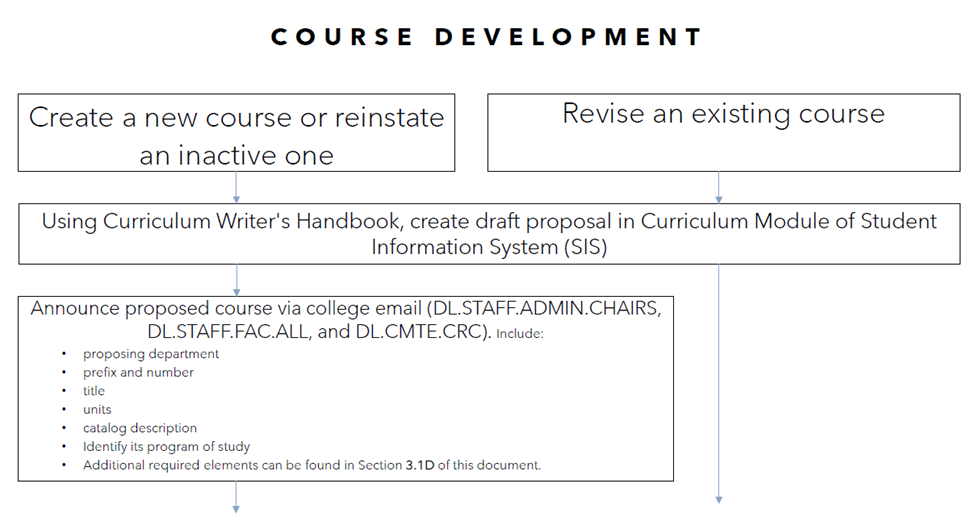
- Initial Steps in New Course Development or Revision
- Discussion and Research
As new knowledge and skills emerge, disciplines do not always fall neatly into one discipline. To avoid unnecessary duplication of content available through regularly offered courses (those courses offered at least every two years), faculty/course submitters (in consultation with department chair) interested in creating a new course must complete research and initiate conversations with disciplines/departments that might have similar content to clarify whether the overlap in the new course is needed.
New course development or course revision requires that course submitters complete research within and beyond the department and in consultation with the department chair. Initially, faculty/course submitters review existing course inventory within and beyond department courses before writing a new course to determine whether a similar course already exists or has existed in the past. Following this, course submitters must gather research regarding new course. Research can include information gathered from sources such as those listed below.
• SRJC’s Public Fact Book
• Labor Market Data for Career Education courses
• Regional Advisory Group for Career Education courses
• Requests vis SRJC’s Institutional Research and Planning Office, such as SRJC student surveys
• SRJC Course Catalog
• Enrollment/success of comps at other institutions (CCCs, CSUs, and UCs)
Faculty submitter (in consultation with department chair) must also initiate and engage in cross-disciplinary conversations with departments/disciplines whose course might contain similar content. Lastly, submitters complete a one-page summary (See Appendix K for template) of their course-related research and evidence of cross-disciplinary conversations to Curriculum Office. This summary will be shared with the Ad hoc committee formed in alignment with CRC Bylaws as part of the Discipline Overlap Process if needed.
Specific criteria must be considered for any newly proposed course; the required criteria are listed below and are fully explained in the PCAH 8th Edition
• Appropriateness to Mission
• Need
• Curriculum Standards
• Adequate Resources
• Compliance
Beyond the five basic criteria listed above, the faculty submitter should also consider the questions below.
• What role does this course have within the educational plans of students?
• For a transfer level course, what are comparable courses at other institutions, and how would the proposed course transfer?
• For a career education course, how will the course fit into a program and/or otherwise prepare a student for work?
• How feasible is this course in terms of faculty, facilities, resources, and scheduling?
Explanation below is excerpted from PCAH 8th Edition :The college must demonstrate that it has the resources to realistically maintain the program or course at the level of quality described in the proposal. This includes funding for faculty compensation, facilities and equipment, and library or learning resources. Additionally, the college must demonstrate that faculty are available to sustain the proposed required course(s) and to facilitate student success. The college must commit to offering all required courses for the program at least once every two years, unless the program goals and rationale for the particular program justify or support a longer time frame as being in the best interests of students.
- New Course Development Steps
1. Complete New Course Proposal Form.
2. Send New Course Announcement by end of Week 12 of a full-length semester. (NOTE: The week number is determined by the semester’s faculty evaluation timeline in accordance with AFA.). New courses announced after Week 12 might not be reviewed by CRC until the following full-length semester; course review depends on current inventory of courses awaiting review.
3. If there is a plan for the course prefix and/or course number to change (e.g. CSU # to a UC #), include current and potential prefixes and course numbers in this initial announcement.
a) To announce a New Course, the discipline/department representative(s) must send an email introducing the proposed course (include future UC number if course is currently numbered from 50-99) during the Fall or Spring semester; the email must be sent out no later than the end of Week 12 in fall or spring semester. The email must be sent to the following distribution lists:
DL.STAFF.FAC.ALL
DL.STAFF.ADMIN.CHAIRS
DL.CMTE.CRC
b) The email must include:
1) the proposing department;
2) the course prefix and number(s); If the course has both CSU and UC number, both numbers should be included in this announcement.
3) the course title;
4) the number of units;
5) the catalog description;
6) if applicable, the name of the program to which the course belongs;
7) a link to the most recent draft of Course Outline of Record; and
8) the CRC- and Senate-approved statement below:
i) If a faculty member (in consultation with their department chair) perceives a conflict regarding discipline or duplication of courses or course content, the faculty member and/or department chair must notify the Curriculum Office of perceived conflict within 3 weeks (during a full-length semester) of the announcement.
4. Course Renumbering Announcement, including prefix changes
a) A department only needs to send an email announcing new course numbers and prefixes if new course numbers and prefixes were not listed in original email announcement)
b) This email must be sent out no later than the end of Week 12 in fall or spring semester.
1) This email must be sent to the following distribution lists:
DL.STAFF.FAC.ALL,
DL.STAFF.ADMIN.CHAIRS, and
DL.CMTE.CRC
2) The email must include:
i) the proposing department;
ii) the course prefix and number(s); If the course has both CSU and UC number, both numbers should be included in this announcement.
iii) the course title;
iv) the number of units;
v) the catalog description;
vi) if applicable, the name of the program to which the course belongs;
vii) a link to the most recent draft of Course Outline of Record; and
viii) the CRC- and Senate-approved statement below:
a. If a faculty member (in consultation with their department chair) perceives a conflict regarding discipline or duplication of courses or course content, the faculty member and/or department chair must notify the Curriculum Office of perceived conflict within 3 weeks (during a full-length semester) of the announcement.
- Discipline Overlap Mediation Process
1. If a department/discipline voices concern within 3 weeks (during a full-length semester) of the announcement, the process outlined below begins as soon as possible within the same semester. Faculty submitters and faculty voicing concern will complete the steps below in consultation with their department chair.
a) The Ad hoc committee formed in alignment with CRC Bylaws will meet to discuss each of the statements described below. The CRC Bylaws read, “Ad hoc committees: Membership and function to be discussed and voted upon by the CRC.”
1) Proposing discipline/department will submit a rationale statement to Curriculum Office to explain justification for a course with similar content. This statement must be submitted by the last day of regular class (not last day of Finals Week) in the current semester.
2) Discipline/department voicing concern will submit a rationale statement to Curriculum Office to explain their perspective, including why there is no need for similar content via newly proposed course and/or to voice concern over minimum qualifications and placement of course content within disciplines. This statement must be submitted by the last day of regular class (not last day of Finals Week) in the current semester.
3) Both rationale statements are shared with the Ad hoc committee formed in alignment with CRC Bylaws within one week of receipt.
4) If additional information is needed, the Ad hoc committee meets with or e-mails each faculty group separately to ask clarifying questions to obtain needed information.
5) The Ad hoc committee makes its recommendation based on the established criteria for new course development as outlined in PCAH 8th Edition and local curricular considerations. Discipline Overlap Process Checklist is available in Appendix J.
i) The Ad hoc committee shares its recommendation with CRC as a Business Item prior to the course being placed on an CRC agenda as an Action Item.
ii) CRC members may ask clarifying questions at this time.
b) The Ad hoc committee submits its recommendation and all supporting materials to Curriculum Office for CRC review.
1) If the Ad hoc committee recommends that CRC reviews the new course, CRC co-chairs place the new course on an upcoming agenda; CRC members will receive all written documentation pertaining to the disciplinary overlap prior to the meeting when the course will be reviewed.
2) If the Ad hoc committee does not recommend the new course for CRC review, the committee provides feedback and guidance to submitting department/discipline for course redesign and/or additional research. Research can include information gathered from sources such as those listed below.
i) SRJC’s Public Fact Book
ii) Labor Market Data for Career Education courses
iii) Regional Advisory Group for Career Education courses
iv) Requests via SRJC’s Institutional Research and Planning Office, such as SRJC student surveys
c) CRC will use regular meeting guidelines to review the course and will allow for 20 minutes for course review.
d) CRC’s decision cannot be appealed; however, the submitter can resubmit the course the following academic year.
- Revised Courses
Determine if changes would be substantial enough to warrant a new course. Certain types of course revisions can significantly change the course, which means a new course proposal is required. (See Section 1.7 Chart).
If revision includes a change in Unit Value (increase or decrease), first, email CRC Co-Chairs, Curriculum Technicians, and Articulation Officer with a request for Unit Value Change along with a rationale statement in alignment with Section 3.2G below. This allows for guidance on how to proceed through the course approval process while still following relevant requirements and policies for that specific course.
- Inactiviating a Course
Sometimes, during course development or Program Review, a department may determine that certain courses should be removed from the current inventory. Inactivation means the course may be resurrected and revised at some time in the future. Course outlines for inactivated courses remain in the Curriculum Database, but the numbers can never be used for any other course in the discipline. To inactivate a course, the department must submit the Curriculum Course Submission Form with the word ‘inactivation’ next to it via the course intake process. Then, the course will be placed on a CRC agenda and deactivated the following academic year.
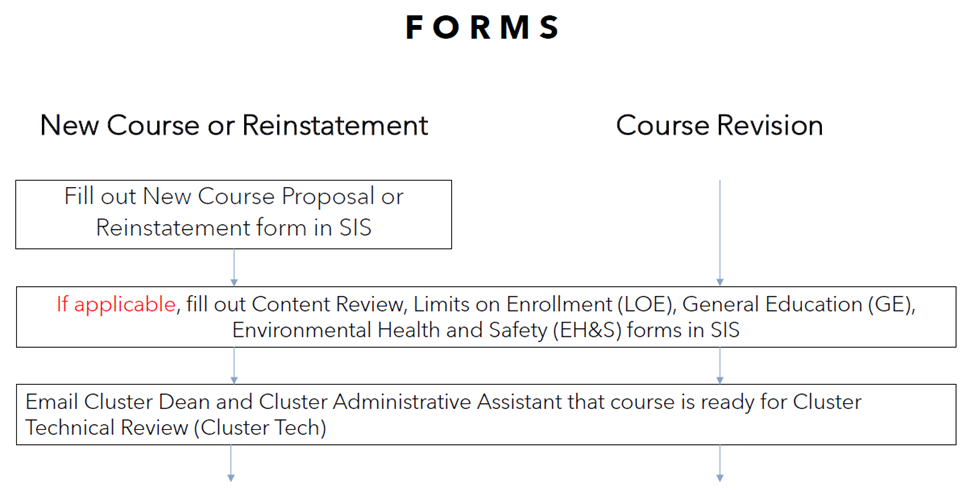
- Writing the Course Outline of Record (COR)
A. Read Curriculum Writer’s Handbook, Sections 3 and 4. These sections provide an overview of the COR’s key components and the COR approval process.
B. Create a draft of course (or make revisions to course) in Curriculum Database. The course submitter or the department's Administrative Assistant enters course content directly into the Curriculum Database. (See Appendix C)
C. Review, revise, finalize. Obtain feedback from department chair and other department members before finalizing the draft.- Complete Aplicable New Course Proposal (New Courses Only)
1. New Permanent Course Proposal (Transferable)
2. New Permanent Course Proposal (Non-Transferable)
3. Reinstatement Transferable Course Proposal
4. Reinstatement Non-Transferable Course Proposal
- Complete Content Review form for courses with prerequisites, corequisites, and/or recommended preparation.
Any course that lists prerequisites, corequisites or recommended preparation must have a Content Review form to show how the required or recommended preparation supports the target course.
- Complete any required additional forms for the course
1. Distance Education Proposal
2. Noncredit Distance Education Proposal
3. Limitation on Enrollment
4. Health and Safety
Note: The above forms are available for preview in Appendix F and on the Curriculum Review Committee’s website. However, the forms must be completed within the Curriculum Database System. Read Section 7.1 to become familiar with transfer guidelines for UCs, CSU, and other transfer institutions.
- Submit Unit Value Change Rational Statement (only if seeking a Unit Value change)
1. A unit value change is sometimes needed for a course. According to ASCCC’s The Course Outline of Record: A Curriculum Reference Guideline Revisited, “Faculty must be thoughtful about units and contact hours, taking into account elements including student need, potential effects on financial aid eligibility, enrollment priorities, and other concerns.” Before requesting a unit value change, faculty should consider the concerns ASCCC has noted along with the factors outlined below, which are referenced in Appendix A sources. Additionally, please note that at SRJC, one unit equals 52.5 total hours of student work, inclusive of in-class and out-of-class learning hours, which aligns Title 5, § 55002.5.
a) Unit Increase--When increasing the unit value of a course, consider:
i) Relevance and necessity of new content; new content
1) should reflect new disciplinary knowledge or skills required within the discipline or related career education pathways.
i) If the new content is relevant and necessary, consider whether or not the new content calls for a new course.
a. Changes within discipline within CCC system and/or CSU or UC system.
2) Are other schools increasing the unit value of the same course?
3) Are other schools using other curricular options, such as:
i) noncredit courses
ii) mirrored courses (see Glossary)
iii) corequisite support courses (see Glossary)
iv) Student success data
4) Does student success data show a significant decrease in course completion and/or next course success or persistence if the course is part of a pathway or sequence of courses within a given major?
i) Does this decrease suggest that more instructional time is needed for existing course content?
ii) If so, what is best option:
a. Lab time
b. Lecture time
c. A corequisite model
5) Financial cost to students
i) A 1-unit increase equals a total of 52.5 additional hours of work at SRJC and requires additional tuition cost, and for some students, there is additional financial impact due to decrease in ability to work while in class, potentially leading to lost wages.
6) Impact on program(s) that include the course either as a required or elective course.
7) Discuss impact on programs with faculty from those departments.
8) Alignment with transfer model curricula and C-ID (see Glossary)
i) Is the increase needed so the course aligns with C-ID or Transfer Model Curriculum (TMC)?
9) Common Course Numbering (CCN)
i) If SRJC’s pre-existing course contains fewer units than the CCN course, SRJC will have to increase the unit value of its course.
b) Unit Decrease--When decreasing the unit value of a course, consider
1) Relevance and necessity of content that is being removed.
i) Will removing content impact articulation?
ii) If course is a prerequisite to another course, will removing content reduce a student’s likelihood of success in target course?
2) Changes within discipline within CCC system and/or CSU or UC system.
i) Are other schools decreasing unit value of the same (or similar) course or are other schools using other curricular options, such as:
a. Noncredit courses
b. Mirrored courses
3) Impact on a student’s Financial Aid eligibility
i) Would a decrease in unit value negatively impact a student’s financial aid eligibility?
4) Impact on program(s) that include the course either as a required or elective course.
i) Discuss impact on programs with faculty from those departments.
5) Alignment with C-ID for CSU equivalent courses.
i) Will the unit reduction maintain course alignment with C-ID and/or with Transfer Model Curriculum (TMC)
6) Common Course Numbering (CCN)
i) If SRJC’s pre-existing course contains more units than the CCN course, SRJC does not have to reduce the unit value of its course.
ii) If SRJC does not have a CCN course already developed and faculty want to develop an SRJC version of that CCN course, the new course must align with the unit value on the CCN template.
2. Unit Value Rationale Statement--If after considering the above factors, faculty submitter/submitting department wants to increase or decrease the unit value of a course, they must submit a rationale statement to the Curriculum Office, Dean of Curriculum, and Articulation Officer that outlines the rationale for the unit value change. This rationale statement will be available as needed during CTRC and CRC meetings.
a) Unit Value Change Rationale Statement
1) If Unit Value Change is needed to match a desired/existing articulation (C-ID or UC course), or TMC, please state that as the rationale; no further rationale statement is needed.
2) If Unit Value Change is requested for reasons other than matching desired/existing articulation, please include the following information:
i) any student data and/or feedback, or other research that helped discipline faculty determine the need for this change;
ii) explanation of any impact this unit value change might have on programs that include this course as a requirement or as an elective; and
iii) description of any trends within the discipline (e.g. new content or skills requirements) that align with this unit value change.
- Secure Required Approvals
Confirm your department chair’s and dean’s support before submitting the course, including support for Unit Value Change if applicable. The dean or supervising administrator will add the course to an upcoming Cluster Tech Review Committee meeting agenda.
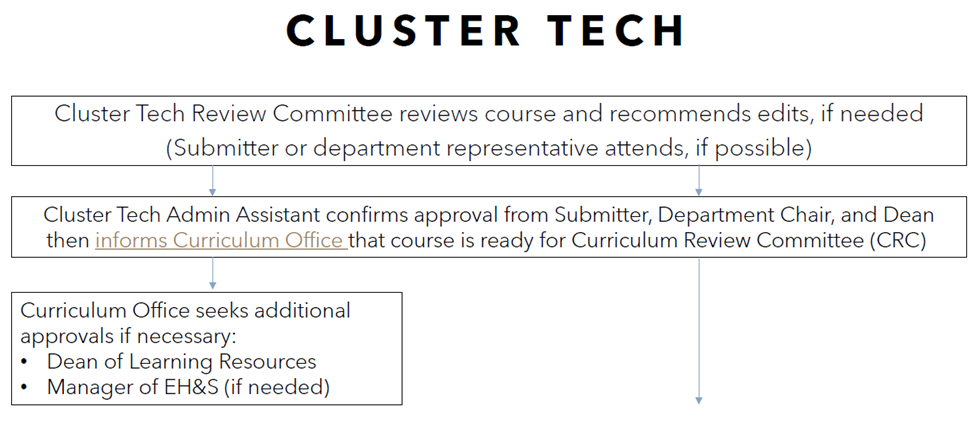
- Submission, Cluster Tech Review, and CRC Subcommittees
Once the COR and required forms are completed and the course is submitted to the dean or supervising administrator, the course moves to the next phase of the course approval process;
Cluster Tech Review Committee (CTRC) meets. Submitters are notified and encouraged to attend the CTRC meeting when their course(s) are reviewed. CTRC review aims to ensure that the course meets all CRC and State requirements. The submitter approves the suggested changes or explains why the change is not needed or not reasonable.
After Cluster Tech Review, if the submitter, department chair, and dean support the latest changes to the COR, then it can be submitted to the Curriculum Office.
CTRC Follow Up-Once the COR has been submitted to the Curriculum Office, one of the CRC Co chairs and/or curriculum technician might contact submitter with a cc to the CTRC seeking additional information or with questions regarding technical issues. For example, a prerequisite on the COR might be inactive or not adhere to Title 5, Section 55003, so the submitter will have the chance to select an appropriate prerequisite, corequisite, or recommended preparation. Other examples include but are not limited to:
formatting;
invalid percentages in Methods of Evaluation;
questions about Limits on Enrollment; or
misalignment between Assignments and Methods of Evaluation.
Subcommittee review. If appropriate, a course will be forwarded by the Curriculum Office, or for GE by the Articulation Officer, for review by the appropriate CRC subcommittee(s) listed below.
Majors & Certificate Review Committee
General Education Subcommittee
Distance Education Advisory Committee (Distance Education Reviewers).
Subcommittee review might occur while the course is also undergoing Cluster Tech Review. A subcommittee may either recommend the course for approval and return it to the Curriculum Office, or if a course does not meet all the criteria, provide feedback to the submitter. Depending upon the feedback, either the submitter or Curriculum Technician will make necessary edits in the Curriculum Database System.
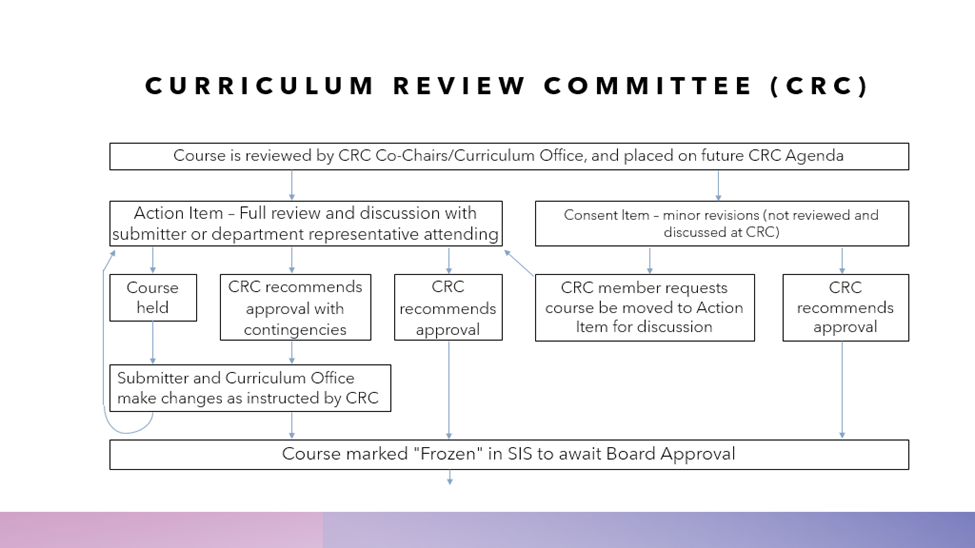
- Curriculum Review Committee (CRC) Actions and Follow-Up
After a new or revised course has gone through CTRC, it is ready to be placed on the next available CRC agenda for full review and voting. Because there is often a backlog of courses awaiting review, it may take several weeks for the course to appear on the agenda. In general, courses are placed on the agenda in the order that they are received in the office after Cluster Tech Review and the Curriculum Submission Form has been submitted to the Curriculum Office.
A. Placement on CRC Agenda and Notification. Once the CRC agenda is set, the submitter, the chair, and the dean will receive a copy of the CRC agenda via email. The submitter, the chair, or a department representative should plan to attend the CRC meeting when the course is discussed as part of the Action Agenda. CRC members’ questions can be answered, minor but important changes clarified, and holding courses can be avoided. Questions/suggestions might include:
• Are SLOs assessable?
• Are key concepts and/or ideas in Catalog Description, SLOs, Objectives present in Topics and Scope
• Is each assignment listed in MOE box represented in the Assignments list.
Priority consideration will be given to courses when a departmental representative is present
B. CRC Voting. At CRC meetings, CRC representatives introduce and discuss courses on the Action Items Agenda. The CRC members might ask course-specific information of the submitter or department representative. If minor changes are needed and the submitter approves them, the Curriculum Technician makes those during the CRC meeting. When the vote (by simple majority) is taken, one of five actions occurs.
1. Course approved after full review. Once a course on the Action Items Agenda is approved, the Curriculum Office notifies the submitter, the department chair, and the dean within a few days after the meeting. The Curriculum Office designates the course “approved” within the Curriculum Database System.
2. Course approved with contingencies. If the course needs minor changes that cannot be made at the meeting, it may be approved with contingencies. The submitter must make these minor changes sometime after the meeting and then notify the Curriculum Office when the changes have been made. Once the Curriculum Dean has verified the changes, the course will be designated as “approved” within the Curriculum Database System; the submitter, department chair and dean will be notified.
3. Course on Consent Agenda approved. Courses are voted upon without discussion. However, CRC members are responsible for viewing courses on the Consent Agenda prior to the meeting. A CRC member who believes a course on the Consent Agenda needs full review must request that course be moved to the Action Items section of the next CRC meeting agenda. This request must occur before or at the beginning of the CRC meeting. This allows time for the Curriculum Office to notify the submitter.
4. Course held. If there are issues concerning the course that cannot be resolved at the meeting, the CRC will hold the course. The submitter, chair, and dean will receive feedback that explains CRC’s concerns and suggestions. When the issues have been resolved, the course is resubmitted to the Curriculum Office to be placed on the appropriate CRC agenda.
5. Course denied. While this rarely occurs, the CRC may vote to deny approval of a course that does not meet local, State, or accrediting body regulations.
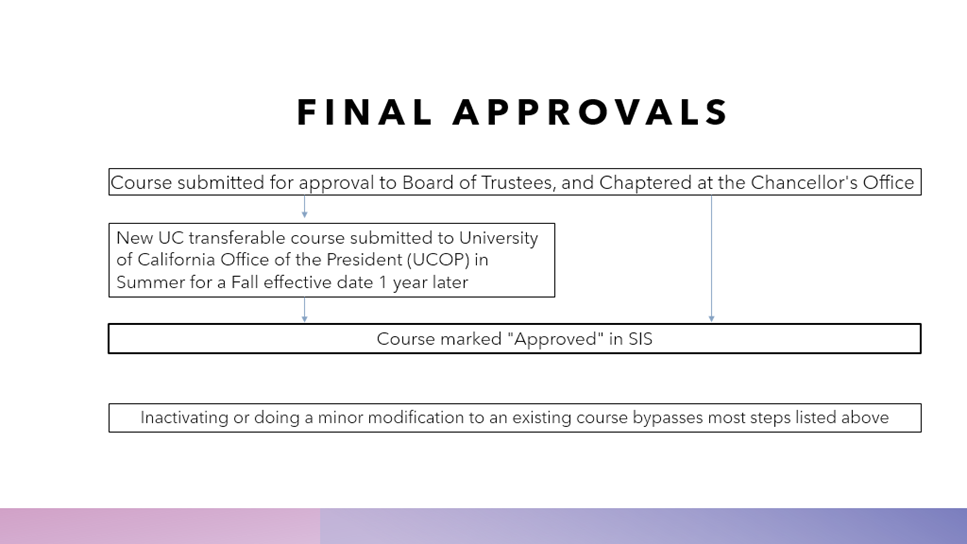
- Final Steps in Approval and Scheduling
After CRC approval, the semester that a course can be offered depends on the type of course. To consistently align with College Catalog rights and SJRC’s Degree/Audit system, approved courses (other than new UC courses) can be offered in the next Fall semester. Approval procedures vary and are outlined below.
Revised credit courses that have been submitted to Curriculum Office by posted deadline may be offered the next Fall semester as soon as they are entered as “approved” in the Curriculum System.
New credit courses that have been submitted to Curriculum Office by posted deadline must be approved first by CRC and then by the Board of Trustees; new credit courses, including stand-alone courses, can be offered the Fall semester following Board approval.
New noncredit courses approved by the Board must then be submitted to Chancellor’s Office. The Curriculum Office will secure the required signatures and email documents to the Chancellor’s Office. When notification of approval is received from the Chancellor’s Office, the courses may be offered the next Fall semester.
New UC Transfer courses (1-49) must be approved by UCOP before they can be offered. The Articulation Office handles articulation agreements and submission of courses to transfer institutions. In general, these courses are offered 1-year after submission to UCOP, which occurs each summer.
Permanent Records. The Curriculum Office keeps a permanent file of all course approval packets, arranged alphabetically by discipline for each academic year.